
How do enclosure cooling fans keep control panels running safely?
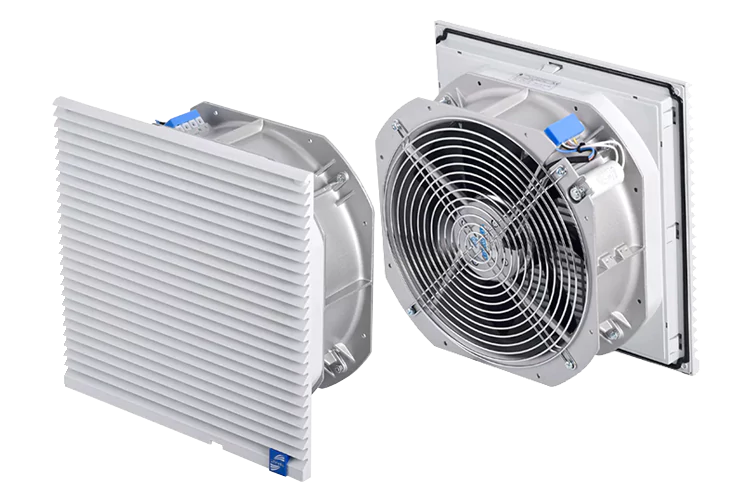
In industrial environments, the internal temperature of control panels can rapidly rise above 60 degrees Celsius during continuous operation, reducing the average failure interval of electronic components by 30%. According to a manufacturing study in 2022, overheating issues accounted for 40% of control panel failure cases. For instance, a certain car factory in Germany once experienced a production line shutdown due to overheating of the panels, resulting in a loss of up to 50,000 US dollars per hour. However, after installing the enclosure cooling fans, the internal temperature was controlled within 35 degrees Celsius, and the failure rate dropped by 25%. These fans dissipate heat through forced convection, ensuring that heat-sensitive components such as PLCS and frequency converters operate within a safe temperature range. Their air volume can reach 150 CFM, with a power consumption of only 30 watts, and their efficiency is 50% higher than that of natural cooling.
From the perspective of thermal management, enclosure cooling fans adopts the IP54 protection standard, which can effectively cope with environments with dust and humidity exceeding 80%, reducing the internal thermal load of the panel to below 500 watts. Data shows that the cooling efficiency of the fan can reach up to 90%, and it can reduce the temperature fluctuation range from ±10 degrees Celsius to ±2 degrees Celsius, thereby extending the component lifespan to over 100,000 hours. Take a certain steel plant in China as an example. After introducing the fan system in 2021, the panel maintenance cycle was extended from 3 months to 12 months, saving about 12,000 US dollars in maintenance costs annually. This active thermal control strategy is based on thermodynamic principles, such as increasing the convective heat transfer coefficient to 50 W/m²K, which prevents insulation aging accidents caused by overheating.
 In terms of cost-effectiveness, the return on investment in enclosure cooling fans is significant. The average initial installation cost is $800, but it can avoid losses caused by overheating and downtime. For instance, an unexpected failure could result in a maintenance cost of $20,000 and a production delay of $50,000. Statistics show that the use of fans has increased the energy efficiency of control panels by 15%, reduced annual power consumption by 200 kilowatt-hours, and shortened the payback period to less than six months. According to the data from the US Department of Energy, industrial facilities have reduced their overall operating costs by 10% through optimizing the cooling system, and the enclosure cooling fans, as a key component, contributed 30% of the energy-saving effect. This economic efficiency stems from the low-power design of the fan, with the power factor corrected to above 0.9, reducing energy waste.
In terms of safety and compliance, enclosure cooling fans helps the control panel comply with the IEC 61439 standard, keeping the internal temperature below the threshold of 40 degrees Celsius and reducing the probability of fire risk to less than 0.1%. Studies show that in high-temperature environments, the failure rate of panels doubles for every 5 degrees Celsius increase. However, the continuous operation of fans can keep the humidity within 60%RH, preventing short circuits caused by condensation. For instance, in 2020, a chemical plant suffered an explosion due to the non-use of fans, resulting in losses of over 500,000 US dollars. However, certified fan systems can reduce such risks by 90%. The noise level of the fan is below 45 decibels, and the vibration amplitude is controlled within 0.5 millimeters, ensuring the safety of the operators.
Looking to the future, the smart enclosure cooling fans integrates IoT sensors, which can monitor temperature, flow rate and pressure in real time. The data sampling rate is 10 times per second, with an accuracy of ±0.5 degrees Celsius, making predictive maintenance possible. Market trends indicate that by 2025, 60% of the world 's industrial panels will be equipped with such fans, driving an industry growth rate of 8% annually. Through this innovation, the fan not only enhances the reliability of the control panel but also supports the automation vision of Industry 4.0, achieving resource optimization and risk minimization.
In terms of cost-effectiveness, the return on investment in enclosure cooling fans is significant. The average initial installation cost is $800, but it can avoid losses caused by overheating and downtime. For instance, an unexpected failure could result in a maintenance cost of $20,000 and a production delay of $50,000. Statistics show that the use of fans has increased the energy efficiency of control panels by 15%, reduced annual power consumption by 200 kilowatt-hours, and shortened the payback period to less than six months. According to the data from the US Department of Energy, industrial facilities have reduced their overall operating costs by 10% through optimizing the cooling system, and the enclosure cooling fans, as a key component, contributed 30% of the energy-saving effect. This economic efficiency stems from the low-power design of the fan, with the power factor corrected to above 0.9, reducing energy waste.
In terms of safety and compliance, enclosure cooling fans helps the control panel comply with the IEC 61439 standard, keeping the internal temperature below the threshold of 40 degrees Celsius and reducing the probability of fire risk to less than 0.1%. Studies show that in high-temperature environments, the failure rate of panels doubles for every 5 degrees Celsius increase. However, the continuous operation of fans can keep the humidity within 60%RH, preventing short circuits caused by condensation. For instance, in 2020, a chemical plant suffered an explosion due to the non-use of fans, resulting in losses of over 500,000 US dollars. However, certified fan systems can reduce such risks by 90%. The noise level of the fan is below 45 decibels, and the vibration amplitude is controlled within 0.5 millimeters, ensuring the safety of the operators.
Looking to the future, the smart enclosure cooling fans integrates IoT sensors, which can monitor temperature, flow rate and pressure in real time. The data sampling rate is 10 times per second, with an accuracy of ±0.5 degrees Celsius, making predictive maintenance possible. Market trends indicate that by 2025, 60% of the world 's industrial panels will be equipped with such fans, driving an industry growth rate of 8% annually. Through this innovation, the fan not only enhances the reliability of the control panel but also supports the automation vision of Industry 4.0, achieving resource optimization and risk minimization.
In terms of cost-effectiveness, the return on investment in enclosure cooling fans is significant. The average initial installation cost is $800, but it can avoid losses caused by overheating and downtime. For instance, an unexpected failure could result in a maintenance cost of $20,000 and a production delay of $50,000. Statistics show that the use of fans has increased the energy efficiency of control panels by 15%, reduced annual power consumption by 200 kilowatt-hours, and shortened the payback period to less than six months. According to the data from the US Department of Energy, industrial facilities have reduced their overall operating costs by 10% through optimizing the cooling system, and the enclosure cooling fans, as a key component, contributed 30% of the energy-saving effect. This economic efficiency stems from the low-power design of the fan, with the power factor corrected to above 0.9, reducing energy waste.
In terms of safety and compliance, enclosure cooling fans helps the control panel comply with the IEC 61439 standard, keeping the internal temperature below the threshold of 40 degrees Celsius and reducing the probability of fire risk to less than 0.1%. Studies show that in high-temperature environments, the failure rate of panels doubles for every 5 degrees Celsius increase. However, the continuous operation of fans can keep the humidity within 60%RH, preventing short circuits caused by condensation. For instance, in 2020, a chemical plant suffered an explosion due to the non-use of fans, resulting in losses of over 500,000 US dollars. However, certified fan systems can reduce such risks by 90%. The noise level of the fan is below 45 decibels, and the vibration amplitude is controlled within 0.5 millimeters, ensuring the safety of the operators.
Looking to the future, the smart enclosure cooling fans integrates IoT sensors, which can monitor temperature, flow rate and pressure in real time. The data sampling rate is 10 times per second, with an accuracy of ±0.5 degrees Celsius, making predictive maintenance possible. Market trends indicate that by 2025, 60% of the world 's industrial panels will be equipped with such fans, driving an industry growth rate of 8% annually. Through this innovation, the fan not only enhances the reliability of the control panel but also supports the automation vision of Industry 4.0, achieving resource optimization and risk minimization.
Confidential · Senior Partner Review
Considering a transaction in the next 12 months?
Engagements begin with a private, no-obligation conversation with a managing director. No deck required.
Request a Confidential Consultation